
Sizing
What Size Dumpster Do I Need? An Honest Largo Guide
Most sizing guides lead with cubic yards. Around here that number is actually useful for once — because the City measures your annual bulky allowance in them too.
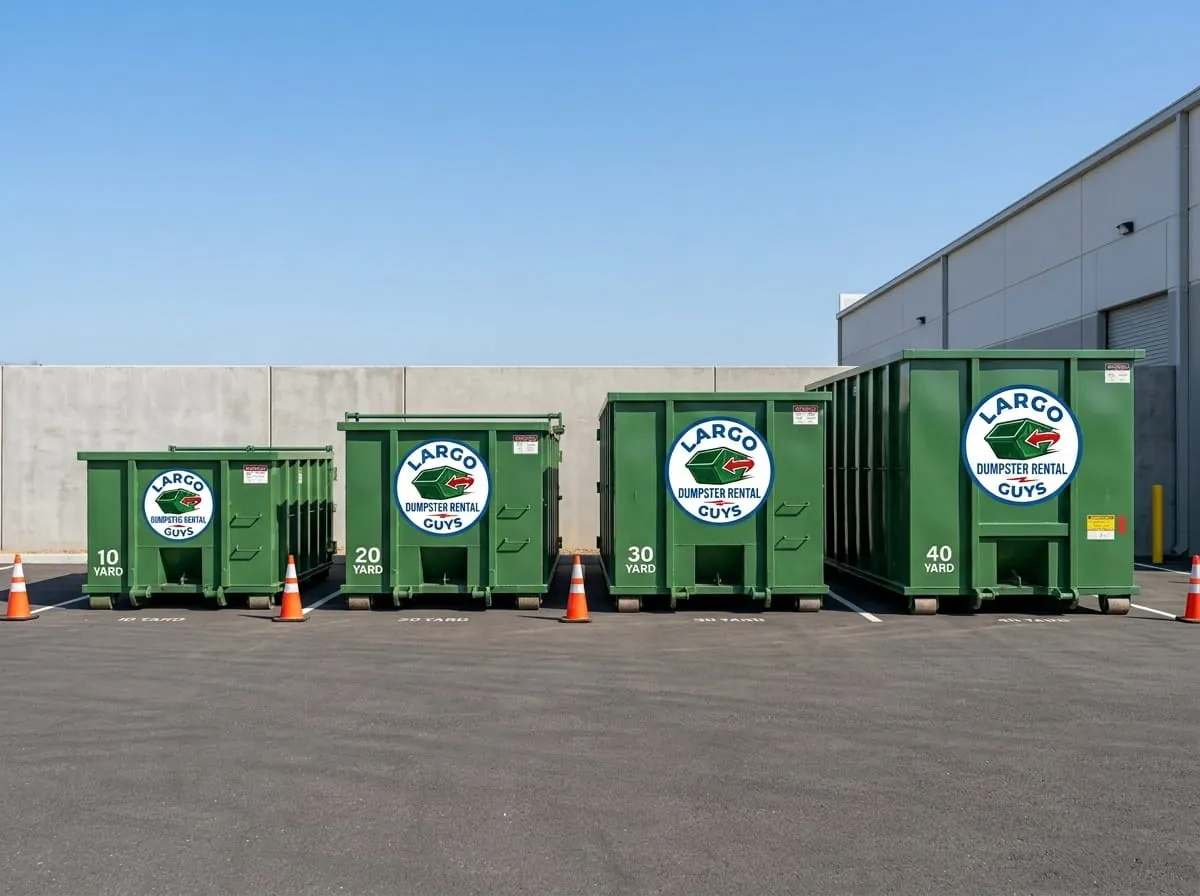
Why cubic yards matters here
Normally we tell people to ignore cubic yards, because almost nobody can estimate their own debris in them. Largo is the exception, and it is worth knowing why.
Ten cubic yards is exactly the size of our smallest container. So your entire annual City allowance is four 10-yard loads, spread across a year, scheduled one at a time. That is a genuinely useful yardstick, and it makes the comparison unusually clear.
What we actually ask on the phone is three questions: what are you throwing away, how much of it in terms you can picture, and where will it sit.
The two constraints: volume and weight
Every container has two limits and you will hit one of them first. Volume is obvious — the box is only so big and you cannot load above the top rail. Weight is the one people forget, and it is the one that costs money.
Each size comes with an included tonnage. A 10 yard typically includes one to two tons, a 30 yard four to five. Go over and you pay a per-ton overage rate, which we quote before you book.
What each size really holds
10 yard — 12 ft × 8 ft × 3.5 ft
Three to four pickup loads. One to two tons. The small-job container and, more importantly, the heavy material container: a bathroom gut, a patio slab, broken block, tile, concrete. Low sides mean you can throw material over the wall without a ramp.
15 yard — 16 ft × 8 ft × 4 ft
Five to six pickup loads. Two to three tons. The most under-used size in the industry and the one we place most often on the barrier islands and the older city streets, where sixteen feet fits and twenty-two does not.
20 yard — 22 ft × 8 ft × 4.5 ft
Seven to eight pickup loads. Three to four tons. The standard container across Largo's own neighbourhoods, Seminole, Pinellas Park and the newer subdivisions where driveways are generous.
30 yard — 22 ft × 8 ft × 6 ft
Ten to twelve pickup loads. Four to five tons. Same footprint as the 20 with eighteen more inches of height, so it holds half again as much without needing any more driveway. The builder's container and the right call for a whole-house clear-out.
Worked examples from real Pinellas jobs
| Job | Size | Why |
|---|---|---|
| Bathroom gut, block walls and tile | 10 yard | Small volume, very dense material |
| Patio or walkway slab removal | 10 yard | Concrete is roughly 2 tons per cubic yard |
| Barrel tile roof tear-off | 10 yard + swaps | Tile is extraordinarily heavy - see below |
| Screen enclosure or lanai rebuild | 15 yard | Aluminium and screen: bulky, very light |
| Island or beach lot, narrow street | 15 yard | Access is the limit, not volume |
| Kitchen renovation, mid-size | 15-20 yard | Cabinetry eats volume; tile floor pushes weight up |
| Shingle re-roof, 26 squares | 20 yard | Around 4 tons of shingle - at the allowance limit |
| Three-bed whole-house clear-out | 20 yard | Furniture and household contents eat volume fast |
| Storm debris, mixed vegetative and structural | 20-30 yard | Huge volume, moderate weight - but separate it |
| Full interior demolition, block house | 30 yard + swap | Volume and weight both high |
Concrete block changes everything
This is the single biggest difference between sizing a job here and sizing one in most of the country, and it catches people who have moved from elsewhere.
Florida houses are overwhelmingly concrete block with stucco on a slab, not timber frame over a basement. So when you take out an interior wall, remove a section of exterior wall, or demolish a lanai, you are not producing studs and drywall — you are producing block, mortar, stucco and rebar.
Roughly 4,000 pounds per cubic yard. A single cubic yard of broken block and mortar weighs about as much as a small car. Two or three yards of it will exceed a small container's weight allowance on its own.
The practical consequence: on any job involving block, put the block in its own 10 yard and everything else in a separate container. That is almost always cheaper than one mixed load, because clean concrete and block have their own disposal route.
The same applies to terrazzo, which is common in the mid-century housing across this county and is heavier again.
Tile roofs are their own calculation
Barrel tile and flat concrete tile are common here and they are the heaviest roofing material we handle — substantially heavier than the asphalt shingle most sizing tables assume.
A tile roof goes in a 10 yard, part-filled, with multiple swaps. Never a 30 yard: you would fill it a fraction of the way and it still could not be legally hauled.
If you are re-roofing and there is tile on it, say so at the booking stage so we can plan the swap schedule rather than discovering it on the day. More on roofing here.
Beach and island jobs size down
On the barrier islands — Indian Rocks Beach, Madeira Beach, Treasure Island, St. Pete Beach — the container size is decided by the street, not the debris.
Narrow lots, tight streets, limited parking and causeway access mean a 15 yard is usually the maximum and a 10 is frequently the sensible choice. Two smaller containers with a swap will often be the only workable shape, and it is worth planning that from the start rather than discovering it when a truck cannot place.
Condominium and association rules add a second layer: many have requirements about where a container can sit, how long it can stay and whether it needs screening. Ask before you book.
How to describe your job on the phone
- What the material is. "Kitchen cabinets, countertop, appliances and about 200 square feet of tile floor" tells us everything.
- Whether there is block, tile or terrazzo in it. It genuinely changes the container.
- Which city, and whether you are on an island. Access varies enormously across this county.
- Whether it is a condo or has an association. Their rules govern placement.
- Whether the property has taken water. Saturated material is far heavier than it looks.
- Where the swale runs, if you are unsure about placement.
That is a ninety-second conversation and it is the difference between a flat rate that holds and a truck that has to leave again.
Need a container in Largo?
Call and describe the job. Three minutes on the phone gets you a size recommendation, a flat rate and a delivery window — and we will tell you if a smaller, cheaper container is the right answer.
Call (727) 615-3557