
Construction
Where Construction Debris Actually Goes Around Largo
The City will not collect construction material left by a contractor. That single line defines the entire market for this service.
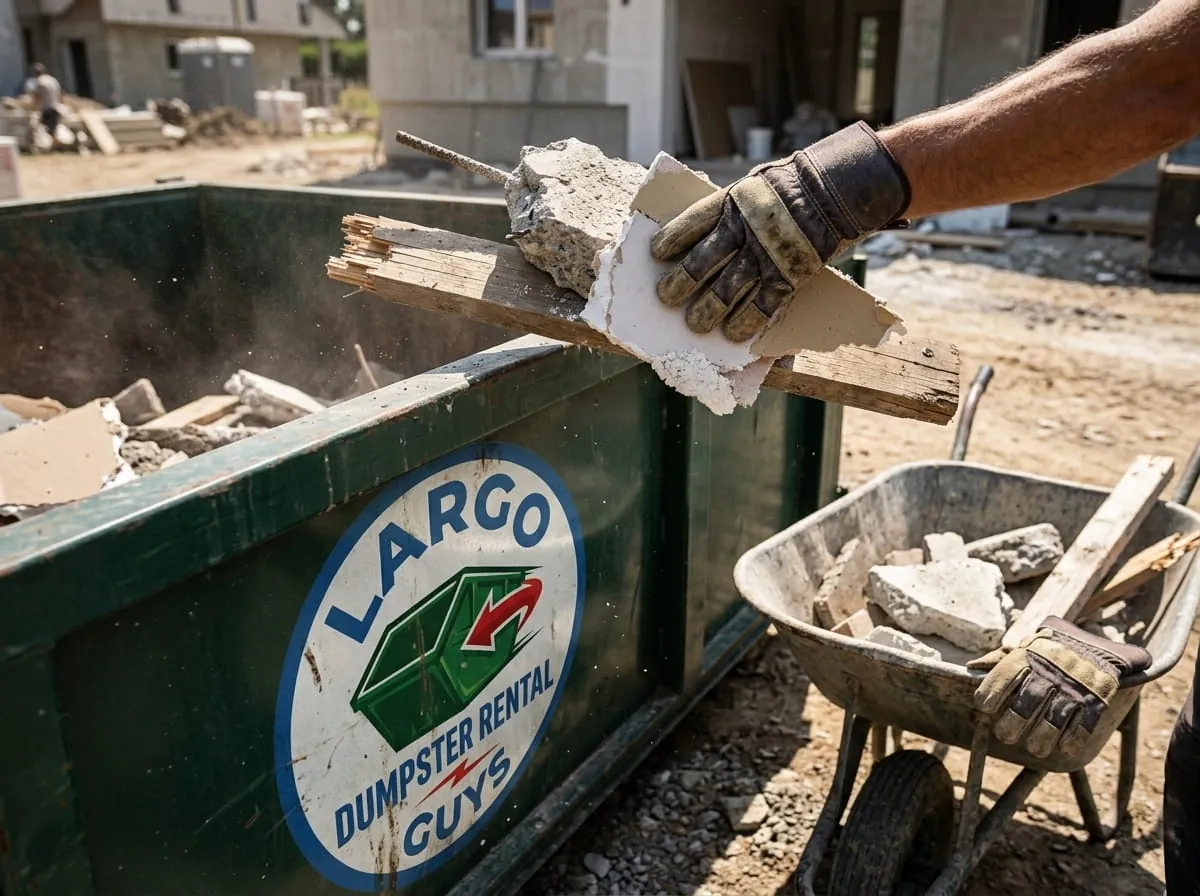
The line the City draws
Every market has a line where municipal collection stops and a container starts. Here it is drawn by who removed the material, which is unusual and worth understanding precisely.
Damaged building components that a homeowner removes — wood, glass, metal, roofing material, tile, carpeting, concrete — do get collected, separated from other waste. The identical pile produced by a contractor does not.
So for any job where a trade is doing the work, there is no municipal route at all. The debris is the contractor's responsibility and a container is how essentially all of them handle it.
Add the residential cap on top — four bulky collections a year at 10 cubic yards each — and even a homeowner doing their own renovation runs out of allowance fast. A single kitchen can be most of one collection.
Why block changes the economics
Florida construction is concrete block and stucco on a slab, and that makes demolition debris here far denser than the equivalent job in a timber-frame market.
Broken block and mortar run around 4,000 pounds per cubic yard. Concrete is similar. Terrazzo, common in the mid-century housing across this county, is heavier again. A cubic yard of any of them weighs about as much as a small car.
The practical consequence is that a container full of block is illegal to haul long before it is full to look at, and that mixing block into a general container is the most expensive thing you can do with it. Clean inert material has its own cheaper disposal route; mixed C&D does not.
The five streams worth separating
1. Clean block, concrete and masonry
Rebar is generally fine. Timber, plastic sheeting and general debris are not. Goes in a 10 yard on its own, part-filled, and it is nearly always cheaper than the alternative.
2. Aluminium and scrap metal
Enormous here. Screen enclosure frames, hurricane shutters, soffit, gutters, railings, ductwork, window frames — salt-air replacement work produces aluminium constantly and it has positive value.
3. Roof tile
Worth separating from general roofing debris because clean tile is inert material and mixed roofing is not.
4. Clean dimensional lumber
Untreated, unpainted, fasteners removed where practical. Treated timber does not qualify, and here that exclusion catches most exterior timber — decks, docks, fences and anything that has been outdoors is nearly always treated.
5. Vegetative debris
On any site clearance, keep palms, branches and brush out of the C&D container. It is a different stream and mixing it in means paying the C&D rate on garden waste.
Tile, terrazzo and other dense surprises
Three weight traps particular to this region, and between them they cause most of the sizing errors we see.
Barrel and concrete roof tile. The heaviest roofing material we handle by a wide margin. A tile tear-off goes in a 10 yard part-filled with swaps, never a large container.
Terrazzo floors. Poured stone and cement, common in 1950s and 1960s Pinellas housing, and substantially heavier than any tile laid over it since. Removing a terrazzo floor is a weight job, not a volume job.
Anything that has been wet. Flood and surge material weighs a multiple of its dry equivalent, and surge leaves sand behind, which is dense. On any water-damaged property we size for weight.
The consistent answer across all three: size down and swap more often rather than filling one big container you cannot legally haul.
Screen enclosures are the opposite problem
Worth its own note because it runs the other way and people get it wrong in the other direction.
Lanai and pool enclosure material — aluminium framing, screen mesh, panels — is extraordinarily bulky and extraordinarily light. A full enclosure will fill a 20 yard and weigh under a ton.
So those jobs get sized up, not down, and the aluminium is worth pulling out separately because there is a lot of it and it has real scrap value. After a storm this is one of the highest-volume categories in the county.
Asbestos and older buildings
Pinellas has a great deal of 1950s and 1960s housing, and pre-1980 material should be treated as asbestos-suspect until surveyed. Floor tile and its mastic are the usual culprits — frequently found underneath terrazzo or later flooring — along with pipe lagging and some textured coatings.
Abatement is licensed work with its own disposal route and it never goes in a roll-off container. Get the survey done before demolition starts rather than halfway through a strip-out.
Everything burns, so the exclusions bite
A point contractors from other states often miss.
All the trash generated in Pinellas County goes to the county's Solid Waste Disposal Complex in St. Petersburg, which includes a waste-to-energy facility. Most of what leaves your site is burned rather than buried.
That makes the prohibited list a safety matter rather than a paperwork one. Batteries — especially the lithium packs in cordless tools — aerosols, propane cylinders, solvents and electronics are all fire and explosion risks in a combustion stream. On a job site with several trades those items end up in the container by accident unless somebody says otherwise on day one.
Practical site setup
- Place containers where the work is, not where they are convenient for the truck. Labour spent walking debris across a site is the largest hidden cost in waste handling.
- Run a separate 10 yard for block and concrete on any job producing it. Nearly always cheaper than one mixed container.
- Label the containers. A sheet of ply marked CLEAN BLOCK ONLY protects the cheaper route.
- Brief the trades on day one about batteries, aerosols and cylinders. One dead tool battery in a load is a genuine hazard here.
- On a narrow island lot, plan the swap sequence first. If there is only one workable placement you cannot run two containers at once, so the job phases around swaps.
- Check the overhead before the trades arrive. Twenty-two feet of clear height, and mature oaks are the usual obstacle.
- Keep the swale clear and keep loaded containers off soft sandy ground.
- Cover it in the wet season. An afternoon storm can add real weight to an open container of absorbent material.
We are happy to help set that up — tell us the build programme and we will schedule around the trade sequence.
Need a container in Largo?
Call and describe the job. Three minutes on the phone gets you a size recommendation, a flat rate and a delivery window — and we will tell you if a smaller, cheaper container is the right answer.
Call (727) 615-3557