Rules
What Can and Cannot Go in a Dumpster: The Largo List
Pinellas burns most of its waste rather than burying it. That single fact explains almost every item on the prohibited list.
The short version
If it came out of a building, a yard or a household and it is solid, non-hazardous and not under pressure, it can almost certainly go in the container. If it is liquid, toxic, pressurised, electronic or contains refrigerant, it cannot.
That covers about ninety-five percent of questions. The rest of this article is the other five percent, which is where the money and the headaches live.
Everything here goes to a waste-to-energy plant
Worth understanding up front, because it makes the whole prohibited list make sense at once.
That changes the risk profile of a load completely. In a landfill county, a lithium battery or an aerosol can buried in a container is mostly a contamination problem. In a combustion county it is a fire and explosion risk — for the truck, for the tipping floor and for the facility.
So when we are firm about batteries, propane cylinders, aerosols and electronics, that is why. It is not box-ticking.
What you can put in
Household and furniture
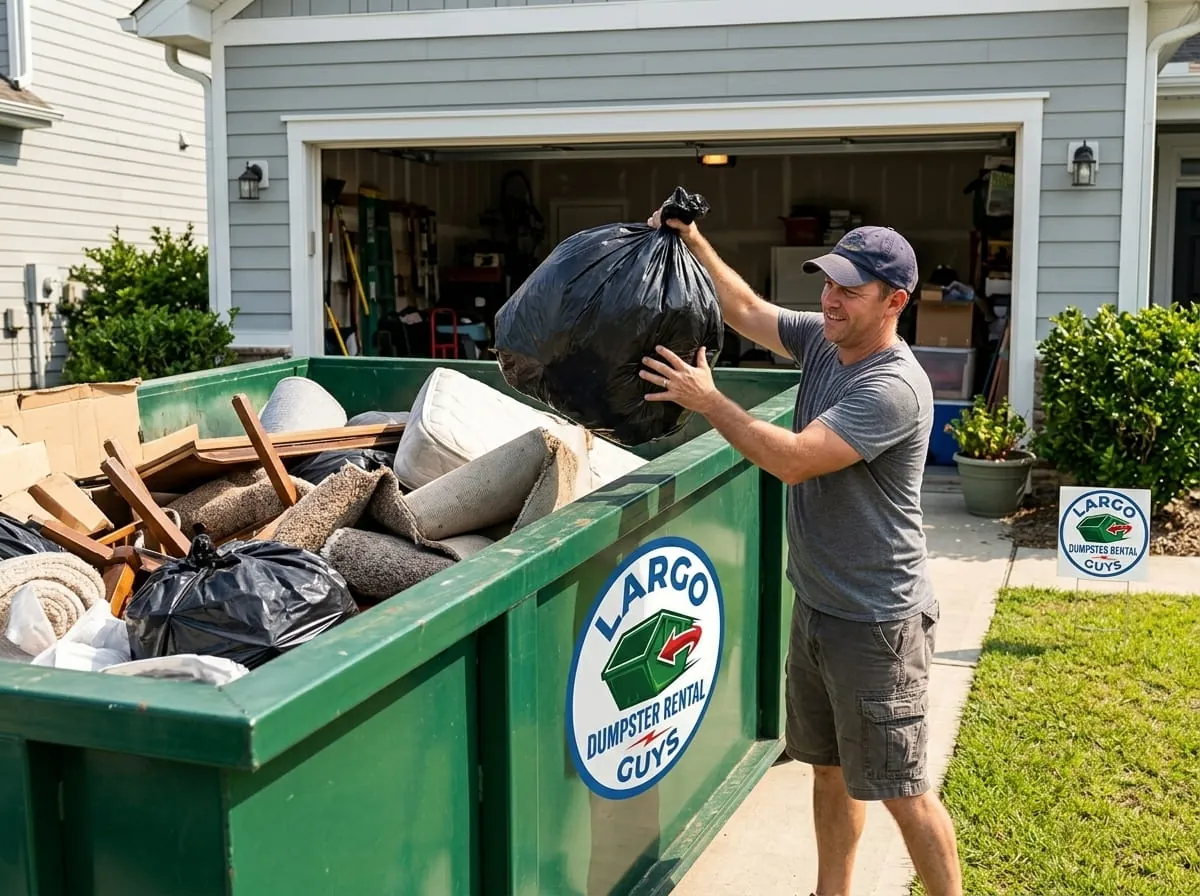
Sofas, armchairs, mattresses, bed frames, tables, wardrobes, bookcases, desks, carpets, rugs, curtains, toys, books, paperwork, kitchenware, patio furniture, grills with the propane tank removed, exercise equipment and general clutter.
Construction and renovation debris
Drywall, timber, plywood and sheet goods, doors, windows, trim, kitchen cabinets, countertops, tiling, laminate and vinyl flooring, insulation, siding, soffit and fascia, guttering, fencing and deck timber, and general non-hazardous building material.
Worth stating plainly: if a contractor generated it, the City will not collect it. A container is the route.
Block, stucco, concrete and tile
All fine, all extremely heavy. These belong in a 10 yard, part-filled. Terrazzo too.
Screen enclosure and lanai material
Aluminium framing, screen mesh, panels and hardware. Very bulky and very light — these containers get sized up, not down, and the aluminium is worth pulling out as scrap.
Roofing
Asphalt shingle, tile, metal panel, felt and synthetic underlayment, flashing and decking. Weight is the constraint, not acceptability.
Vegetative debris
Branches, palm fronds, brush, hedge and stumps within reason. Fine in our containers.
What is prohibited
- Liquids of any kind — paint, stains, solvents, thinners, oils and fuels
- Batteries of every kind, and lithium batteries especially — a genuine fire risk in a combustion stream
- Propane, gas and pressurised cylinders, including "empty" ones, and aerosols
- Electronics — televisions, monitors, computers. These go to the County
- Refrigerant-charged equipment that has not been professionally evacuated
- Asbestos-containing material — possible in pre-1980 floor tile, mastic and pipe lagging. Licensed abatement only
- Pesticides, herbicides, pool chemicals and fertiliser — pool chemicals are everywhere here and are a serious oxidiser hazard
- Medical and infectious waste, including sharps
- Tyres
- Hot ashes or anything smouldering
- Contaminated soil
- Fluorescent tubes and older ballasts
The grey areas people ask about
Pool chemicals
The most common dangerous item in a Pinellas garage. Chlorine tablets, shock, acid and algaecide are all household hazardous waste and none of them belongs in a container — several are strong oxidisers that react badly with organic material. County household hazardous waste, always.
Hurricane shutters and panels
Aluminium and steel panels are fine and worth separating as scrap. Polycarbonate panels go in as general material.
Mattresses
Fine in the container here. Worth saying because rules differ sharply by state and people who have moved from the northeast often assume otherwise.
Treated timber
Acceptable in a mixed load, not in a clean-wood container. Dock, deck and fence timber here is nearly always treated, and older dock timber may be heavily so.
Appliances with a compressor
Fridges, freezers and window air conditioning units need the refrigerant professionally evacuated first. Note that after a storm the City asks that damaged appliances at the curb are not disassembled, precisely because of what is inside them.
Palm fronds and stumps
Fine, but they are bulkier than they look and a stump ball holds a surprising amount of sand. Sand is weight.
What the City will not collect either
Useful to know before you stack things at the curb:
- Chemicals and hazardous materials — excluded from bulky waste entirely, and the ordinance prohibits hazardous and biohazardous waste in solid waste collections
- Electronics — the resident takes these to a County household hazardous waste site
- Construction material left by a contractor — not collected, at all
And a placement rule that matters more here than people expect: bulky items must go near the curb of the right-of-way without blocking sidewalks, streets or swales. Blocking a swale is a drainage problem in a county this flat, and it is taken seriously.
Where the rest has to go
| Material | Where it goes |
|---|---|
| Pool chemicals, pesticides, solvents | Pinellas County household hazardous waste |
| Paint - latex and oil | County household hazardous waste |
| Batteries, including lithium | County household hazardous waste - never the container |
| Televisions, monitors, computers | County electronics collection |
| Propane cylinders and aerosols | County household hazardous waste |
| Fridges, freezers, AC units | Refrigerant evacuated first, then acceptable |
| Tires | County programme or a tire retailer |
| Asbestos | Licensed abatement contractor only |
| Contractor construction debris | A container - excluded from City collection |
The County runs a "Where Does it Go?" lookup for individual items, which is genuinely the fastest way to settle an argument about one specific thing.
A pre-load checklist
- Walk the garage and pull out every chemical, especially pool chemicals
- Check for batteries — power tools, garden equipment, mobility scooters, e-bikes
- Pull out propane cylinders and aerosols, including "empty" ones
- Set electronics aside for the County
- Check any appliance with a compressor for refrigerant
- If the building predates 1980 and you are disturbing floor tile, mastic or pipe lagging, stop and get it tested
- Set aside clean aluminium and scrap metal — it has value
- Load flat and heavy first, bulky on top, and stop at the rail
- Cover it if heavy rain is forecast
Need a container in Largo?
Call and describe the job. Three minutes on the phone gets you a size recommendation, a flat rate and a delivery window — and we will tell you if a smaller, cheaper container is the right answer.
Call (727) 615-3557