
Storm season
Hurricane Debris Cleanup: What the City Takes and What It Does Not
After a storm the rules change, and the single most useful thing you can know is that the piles have to be six feet apart.
Before the season starts
Hurricane season runs June through November and the useful preparation happens in May, not in the forecast cone.
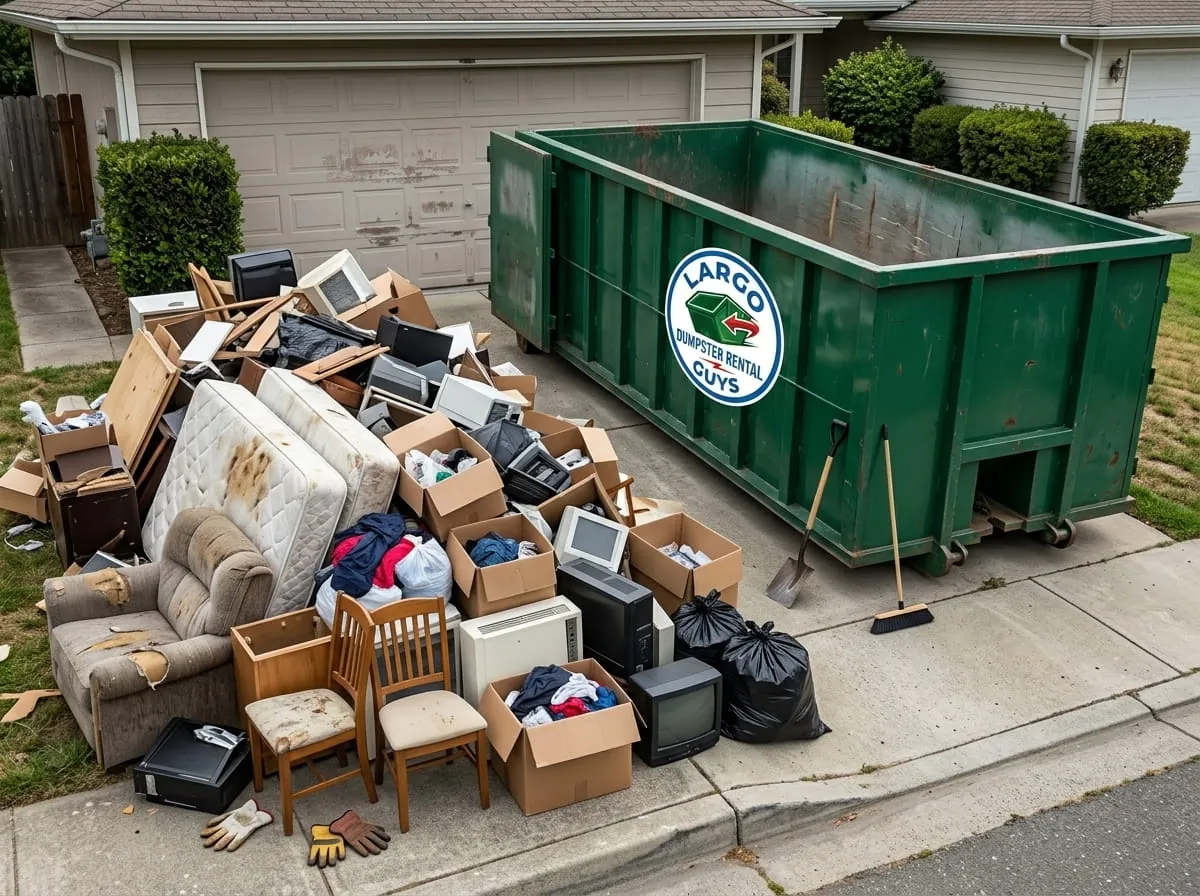
The single most valuable thing you can do for debris purposes is clear the yard before the season: dead limbs, loose fencing, old furniture, the pile behind the shed. Anything loose becomes either a projectile or debris, and doing it in May means using one of your four annual bulky collections at a calm moment rather than competing with the whole county afterwards.
Second most valuable: know where your swale runs and keep it clear. In a county this flat, drainage is everything, and a blocked swale turns a rain event into standing water.
The separation rule is the whole thing
If you take one thing from this article, take this.
It sounds fussy standing in a wrecked yard. It is not. Storm debris collection is run by different trucks and different contractors for different material streams, and a commingled pile cannot be picked up by any of them. A mixed heap gets passed over repeatedly while separated piles either side of it disappear.
The six feet is so the grapple truck can take one pile without contaminating the next. Give it the room.
The four piles
Vegetative debris
Tree limbs, branches, palm fronds, shrubs and leaves. Place it at the curb. You do not need to cut limbs down to size — the grapple trucks handle large material. Critically, limbs and branches must not be commingled with anything else.
Construction material
Damaged building components — wood, glass, metal, roofing material, tile, carpeting, concrete. If you removed it from your own property, the City's contractor will collect it, separated from the other streams.
Appliances
Place damaged appliances at the curb and do not disassemble them. They may contain refrigerants and other toxic components and need special handling. Taking the door off or pulling the compressor out makes them harder to handle, not easier.
Hazardous material and electronics
These are not collected at the curb at all. The resident takes them directly to a Pinellas County household hazardous waste collection site. After a flood this pile is bigger than people expect: soaked electronics, garage chemicals, pool chemicals, paint, fuel cans and batteries.
What the City will not collect
The exclusion that causes the most friction after a storm:
The distinction is who removed it, not what it is. The same pile of ruined drywall and cabinets is collected if the homeowner tore it out and is not collected if a contractor did. Commercial generators are required to dispose of their own debris under the ordinance.
This matters enormously in the weeks after a storm, because that is exactly when most people hire a remediation or rebuild contractor. Plenty of homeowners have piled contractor debris at the curb, watched it sit for weeks and assumed the City was behind schedule. It was not going to be collected at all.
If you are hiring anyone to do the work, establish in the contract who removes the debris and how. Reputable contractors price it in.
Where a container fits in
Three situations, and they are common:
You have hired a contractor. Their debris is not collected. A container is the route, and it should be in the contract.
You cannot wait. Curbside storm debris collection across a whole county takes weeks and sometimes months. If you are drying out a house, dealing with an insurer or trying to make it habitable, a container on the driveway lets you work at your own pace instead of the queue's.
You want it off the right-of-way. A large pile at the curb for a month is a hazard, a drainage problem and a neighbourly one. A container holds the same material in a defined footprint.
We will be honest with you about this: if you have a modest, separable, tidy pile and no deadline, the City collection is free to you and you should use it. If any of the three above apply, call us.
Storm surge material is different
Pinellas is a low, flat peninsula and surge reaches a long way inland, which produces a category of debris that behaves unlike anything else.
It is far heavier than it looks. Saturated drywall, insulation, cabinetry, flooring and furniture weigh a multiple of their dry equivalent. A container that would take a whole house's worth of dry material will hit its weight allowance at half volume with flood material. Tell us it is flood debris and we size for weight.
It comes with sand and silt. Surge deposits it everywhere, and sand is dense. It adds real tonnage to a load that looks like light material.
It has to come out fast. In this climate mould establishes in a couple of days, so wet drywall and insulation need removing quickly rather than neatly. That is precisely when waiting weeks for a curbside queue is not viable.
Some of it is contaminated. Surge water carries whatever it passed through. Gloves, boots and sensible caution, and anything questionable goes to the County rather than the container.
Timing, and why the queue is long
After a significant storm every household in a county of nearly a million people generates debris in the same week. Collection is run by contractors mobilised for the event, working through zones. It is not slow because anyone is failing; it is slow because the volume is extraordinary.
Two practical consequences. First, our own capacity tightens sharply in that period too — we are honest about what we can deliver and when rather than promising the same-day service we run the rest of the year. Second, customers who call early get scheduled; customers who wait to see whether the City gets to them first often call three weeks in.
If you are on the barrier islands, add bridge access to the calculation. Everything moving on or off Indian Rocks Beach, Madeira Beach, Treasure Island or St. Pete Beach crosses a causeway, and after a storm those are the constraint.
Getting alerts that are actually accurate
Storm-time information is where misinformation spreads fastest, and neighbourhood groups get it confidently wrong every season.
Go to the source. The City runs a text alert service — text LARGORECYCLES to 727-425-4004 — for holiday schedules and service disruptions, and publishes schedules at LargoRecycles.com. Pinellas County runs a "Where Does it Go?" lookup for individual items.
Two things worth checking rather than assuming. First, whether your address is actually in the City of Largo: large parts of the county are unincorporated even where the mailing address says Largo, and unincorporated property owners arrange their own hauling. Second, whether the rules you are reading are Largo's at all — Clearwater, St. Petersburg and Pinellas Park all run their own programmes and their storm arrangements are their own.
Storm arrangements change with each event. Debris collection after a declared emergency is set up event by event and the details differ every time. Everything above reflects the City's standing guidance; check the current announcements after any specific storm.
Need a container in Largo?
Call and describe the job. Three minutes on the phone gets you a size recommendation, a flat rate and a delivery window — and we will tell you if a smaller, cheaper container is the right answer.
Call (727) 615-3557