
Practical
Protecting Your Driveway — and Staying Out of the Swale
A loaded roll-off puts several tons on four small steel contact points. On sandy ground beside a drainage swale, that matters more than people expect.
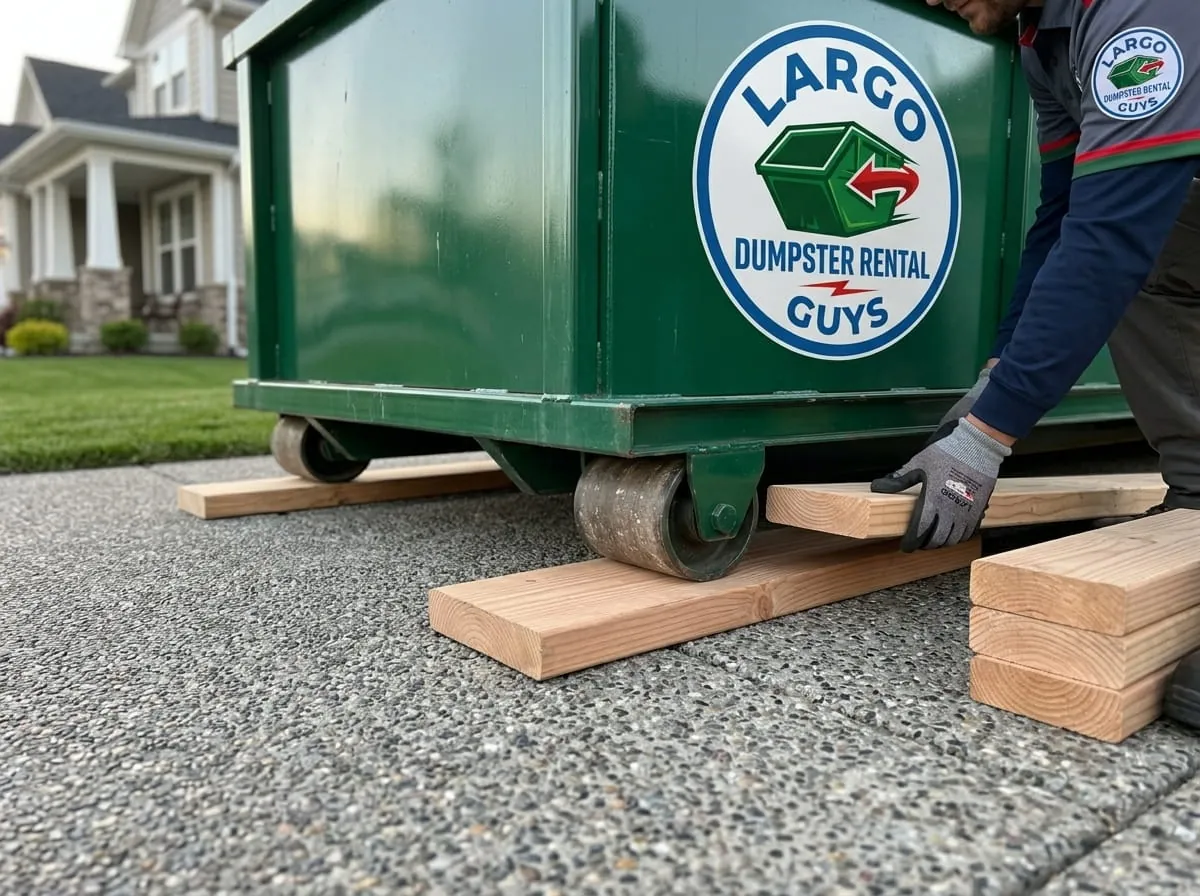
How the damage actually happens
People picture the container's weight spread across its footprint. It is not. A roll-off sits on two steel rails and concentrates load at a small number of contact points — typically the rear wheels and the front of the rails.
A 20 yard loaded to four tons, plus the container's own weight, puts something in the order of several thousand pounds onto each of those points. Three mechanisms follow:
- Static load. The container sitting there over days, gradually pressing in.
- Dynamic load during delivery. The moment the container rolls off and the rear wheels touch down is the highest instantaneous load of the whole rental.
- Dragging. Winching the container back on drags the rails across the surface.
What protection boards do
Timber or plywood under the rails spreads a point load across a much larger area. It is unglamorous and extremely effective — the difference between several thousand pounds on four small contacts and the same weight distributed across several square feet.
Our drivers carry boards on every truck as standard equipment. They go down before the container touches the surface, not afterwards, and again on collection because the drag-on is as damaging as the drop-off. On pavers we double up.
Pavers deserve a specific mention here because they are everywhere in this county — driveways, pool decks, walkways. The pavers themselves are strong; it is the sand bedding underneath that displaces, and once it does the surface is uneven permanently. Doubled boards and lifting rather than dragging are the answer.
The swale is not spare parking
The Florida-specific one, and worth understanding rather than just obeying.
The swale is the shallow grassed channel between the sidewalk and the street. It is not decorative and it is not spare verge — it is stormwater infrastructure. In a county this flat and this low, surface drainage does the work that storm sewers do elsewhere, and a swale that has been flattened, compacted or blocked stops draining.
The City's own bulky waste rules make the point explicitly: items must not block sidewalks, streets or swales. The same applies to a container, and for two reasons.
First, blocking it is a drainage problem for you and your neighbours in the next heavy rain. Second, the swale is the worst ground on the property to put a loaded container on — it is soft, often damp, and by design it holds water. A container placed there will sink, rut and possibly need a second truck to recover.
Keep containers on the driveway. If there is genuinely no driveway, talk to us before booking so we can plan it properly rather than improvise on the day.
Sandy soil and bearing
Pinellas soil is sand, and sand behaves differently from the clay and loam this equipment mostly works on elsewhere.
Dry, well-compacted sand is reasonable bearing. Loose sand is not — a wheel finds its way down through it rather than sitting on top. And saturated sand, after a serious rain, offers very little support at all.
Practically: grass and bare ground placement is fine here in dry conditions on firm compacted ground, and a poor idea in the wet season or within a day or two of heavy rain. When in doubt we place on the hard standing and you carry the debris a few extra feet, which is a much better outcome than a rutted yard.
Surface by surface
Concrete driveway
Generally fine with boards down. Watch for existing cracking, lifted edges and any section that sounds hollow underfoot — a slab already cracked will preferentially fail along that line.
Pavers
Extremely common here. Doubled boards as standard, and we lift rather than drag. The sand bedding is the vulnerable part, not the pavers.
Asphalt
Less common on residential driveways here than up north, but it exists and it softens in genuine summer heat. Boards are essential, and mid-afternoon in August is the worst time to place on it.
Shell and gravel
Found on older and rural-edge property. Forgiving of weight, but the container will settle into it and it may need raking afterwards.
Grass, sand and bare ground
Fine when dry and firm. Poor in the wet season. Never in the swale.
The wet season adds weight
From roughly June through September, afternoon thunderstorms here are close to a daily event, and they are heavy rather than showery.
An open container of absorbent material — drywall, carpet, insulation, cardboard, furniture, yard waste — will take on real weight over a wet fortnight. That weight is charged, because we pay to dispose of it by the ton.
The fix is simple and free: keep it covered. A tarp over the container between working sessions is worth more in this climate than almost any other single thing you can do to control the cost of a rental.
The same applies to the load in general. If you are throwing away material that has already been wet — flood debris, a soaked carpet, saturated drywall — tell us, because it weighs a multiple of its dry equivalent and we will size accordingly rather than surprising you.
Sinkholes and soft ground
Worth a note because this region genuinely has them and people ask.
A roll-off container does not cause sinkholes. The loads involved are trivial compared to the geology, and anyone telling you otherwise is confused. But sinkhole activity is a real feature of west central Florida, and if a property has a known history, or if there are the usual signs — depressions in the yard, cracking in a slab or a driveway, doors and windows that have gone out of square — then it is worth mentioning when you book.
The reason is practical rather than dramatic: we will place well away from any known depression or repaired area, on the firmest hard standing available. That is sensible on any property with unusual settlement, whatever the cause.
If something does go wrong
It is uncommon, but it happens. Tell us straight away rather than after the container is gone. Photograph it. We are licensed and insured, and where damage results from our placement we deal with it rather than arguing about it.
What we cannot take responsibility for is damage from a hazard nobody told us about — a septic system, well, irrigation line or pool plumbing we did not know was there, or a driveway already failing that we were not shown. Irrigation systems are close to universal here and their lines run shallow.
The short version
- Boards go under the rails on every delivery. If a hauler does not do this as standard, use a different hauler.
- Doubled boards on pavers, always — it is the bedding sand that fails, not the pavers.
- Never in the swale. It is drainage infrastructure and it is the softest ground on the property.
- Tell us about irrigation lines, septic, wells and pool plumbing.
- Avoid grass and sand placement in the wet season.
- Keep it covered. Rain is weight you pay for.
- Photograph existing damage before delivery.
Need a container in Largo?
Call and describe the job. Three minutes on the phone gets you a size recommendation, a flat rate and a delivery window — and we will tell you if a smaller, cheaper container is the right answer.
Call (727) 615-3557